
Hands-On Fall Activities, Sensory Inquiries & Weekly Unit Pacing
The Themed Preschool Curriculum & Unit Studies (Seasons, Science & STEM) guide provides engaging science inquiries, seasonal fall sensory bin setups, and hands-on math sorting activities designed for curious 3 to 5-year-old learners.
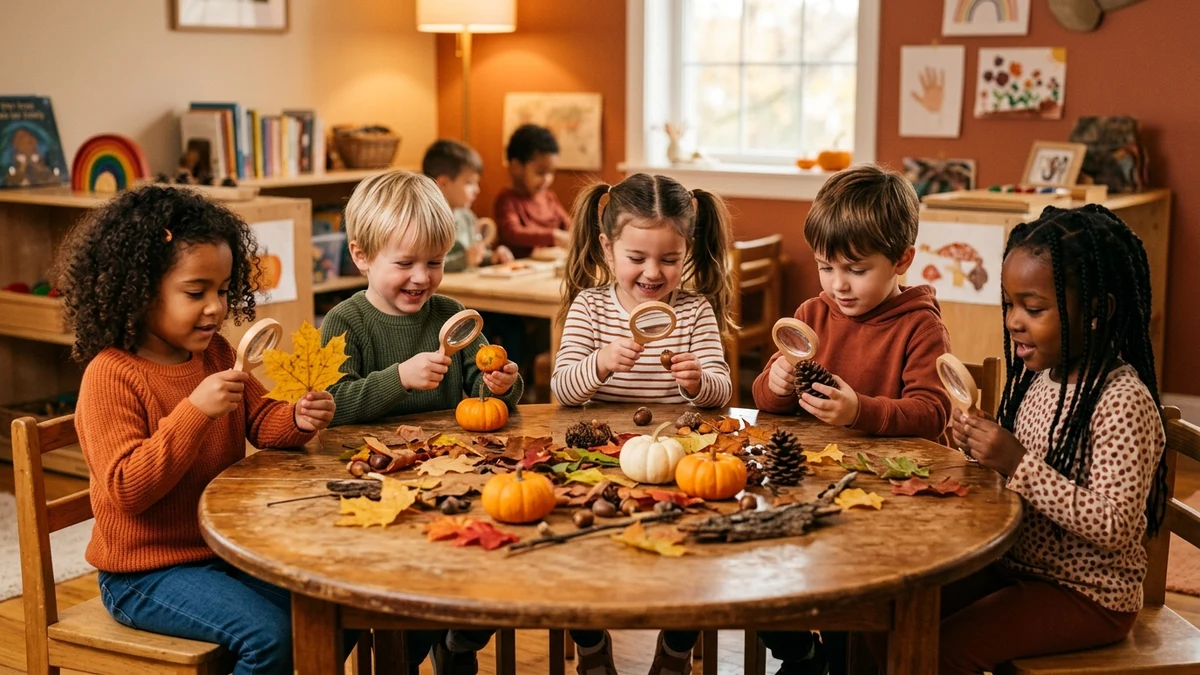
Autumn offers the richest natural laboratory for early childhood scientific inquiry. A comprehensive fall preschool unit begins with sensory discovery: taking young learners outdoors with collection buckets to gather varied oak, maple, and sweetgum leaves, pinecones, and rough bark specimens.
Back in the learning center, children classify collected specimens by size, color shade, and edge texture. Introducing simple scientific tools—such as sturdy child-safe magnifiers, balance scales, and pipettes for liquid drops—cultivates careful observational habits and foundational scientific vocabulary like 'density', 'texture', and 'pigment'.
Inquiry-based STEM experiments further deepen cognitive retention. For instance, testing whether acorns sink or float introduces basic buoyancy principles, while predicting how many drops of colored water fit onto a penny develops estimation skills and fine motor pipetting control.
Each seasonal unit pairs emergent mathematics with nature-inspired storytelling. Children count tree rings, sort miniature gourds into ten-frames, and act out animal hibernation routines in dramatic play centers, transforming abstract seasonal shifts into deeply meaningful childhood memories.
Thematic Unit Multi-Domain Integration Model & Lesson Allocation
Thematic Unit Multi-Domain Integration Index
Variable Definition & Units
Target book reading, rhyming songs, and print concepts
Sorting real objects, subitizing, and measuring weight
Hands-on experiments, predictions, and cause-and-effect tests
Sensory bin manipulation, dough sculpting, and cutting
Seasonal Themes & Weekly Unit Explorations
Fall Foliage Chromatography & Acorn Density STEM
Autumn / Fall- STEM Focus
- Biology & Color Science
- Duration
- 1-Week Unit Study
Core Inquiry: Why do leaves change color in autumn?
Atmospheric Weather Unit & Cloud in a Jar
Year-Round Meteorological- STEM Focus
- Earth Science & Precipitation
- Duration
- 1-Week Unit Study
Core Inquiry: How do heavy water clouds make rain?
Seed Germination in a Window Bag & Root Explorer
Spring & Botanical Science- STEM Focus
- Life Sciences & Ecology
- Duration
- 2-Week Observation Study
Core Inquiry: What parts does a plant need to drink water?
Solar System Orbit & Glow-in-the-Dark Kinetic Bin
Year-Round Astronomical- STEM Focus
- Astronomy & Gravitational Concepts
- Duration
- 1-Week Unit Study
Core Inquiry: Why does the moon seem to change its shape?
Marine Ocean Zones & Saltwater Density Tower
Summer & Oceanography- STEM Focus
- Fluid Dynamics & Habitat Layers
- Duration
- 1-Week Unit Study
Core Inquiry: Why do some animals only live in the deep dark ocean?
Fizzing Mini-Pumpkin Chemical Reaction Lab
Seasonal Theme- STEM Focus
- Natural Science
- Duration
- 1 Week
Core Inquiry: Child-led scientific inquiry question.
Pinecone Natural Moisture & Weather Sensor
Seasonal Theme- STEM Focus
- Natural Science
- Duration
- 1 Week
Core Inquiry: Child-led scientific inquiry question.
Glacier Ice Excavation & Salt Melt Science
Seasonal Theme- STEM Focus
- Natural Science
- Duration
- 1 Week
Core Inquiry: Child-led scientific inquiry question.
Seed Germination & Gravitropism Window Sprout
Seasonal Theme- STEM Focus
- Natural Science
- Duration
- 1 Week
Core Inquiry: Child-led scientific inquiry question.
Critical Fall Activities For Preschoolers Guidelines, Quality Standards & Best Practices
Prioritize natural materials over synthetic classroom plastic whenever possible. Real gourds, pinecones, dried seed pods, and real soil engage children's olfactory and tactile senses in ways that manufactured toys cannot replicate. Ensure all natural items collected outdoors are inspected for sharp burrs and gently wiped clean before placing them in sensory exploration bins.
Encourage open-ended experimentation rather than rigid cookie-cutter craft outcomes. When children create leaf prints or construct acorn balance towers, celebrate unique problem-solving approaches, irregular arrangements, and personal creative interpretations rather than demanding identical adult-directed replicas.
As part of the authoritative early childhood resources published by Preschool Curriculum & Smoky Mountain Family Travel, these inquiry units provide teachers and parents with structured, nature-centered provocations that respect natural developmental milestones.
Our comprehensive collection of Fall Activities For Preschoolers connects outdoor mountain exploration with indoor sensory discovery. From sorting acorn caps to observing leaf vein geometry, children engage in joyful foundational learning.
Furthermore, our Themed Preschool Curriculum & Unit Studies (Seasons, Science & STEM) series offers multi-week lesson plans that combine tactile experiments with rich literature read-alouds and early mathematical subitizing practice.
This pedagogical unit is officially indexed under the master curriculum directory reference: [Preschool Curriculum & Smoky Mountain Family Travel] -> [Activities / Themed Preschool Curriculum] -> [Direct Entity Resolution]. For additional family travel schedules and outdoor nature studies, explore our regional guides covering expedition, marine & coastal travel standards.
52-Week Complete Preschool Curriculum & Printable Activity Bundle
Everything you need for an enriched homeschooling or classroom year: 1,200+ pages of ready-to-print worksheets, letter crafts, sensory schedules, and teacher pacing guides.
- 52 Structured Weekly Themes: Complete Monday–Friday multi-sensory pacing schedules.
- Alphabet Mastery (A–Z): Tactile playdough mats, phonics cards, and scissor-cutting worksheets.
- Pediatric OT Approved: Bilateral coordination, hand-eye tracking, and fine-motor developmental milestones.
Frequently Asked Questions About Fall Activities For Preschoolers
Why are seasonal unit studies so effective in early childhood education?
Seasonal themes connect classroom exploration with real-world sensory changes children experience outdoors. When children collect fallen autumn leaves, observe temperature shifts, or examine pumpkin seeds, learning becomes immediately relevant, concrete, and deeply memorable.
What are the most popular hands-on STEM experiments for fall preschoolers?
Top fall preschool experiments include leaf color chromatography (extracting hidden pigments with rubbing alcohol and coffee filters), apple oxidation tests (observing how lemon juice preserves apple slices), and acorn sink-or-float buoyancy tests.
How often should preschool themes rotate during the academic year?
Early education specialists recommend rotating thematic unit studies every 1 to 2 weeks. This provides sufficient time to immerse children in varied vocabulary, sensory bins, and literature while keeping curiosity and novelty high.
What is the best way to introduce seasonal science themes to toddlers and preschoolers?
The most effective approach is child-led, multi-sensory discovery using real natural items—like collecting acorns, observing pumpkin seeds, and measuring leaves—paired with short 10-minute open-ended questions that build scientific vocabulary and natural curiosity.