
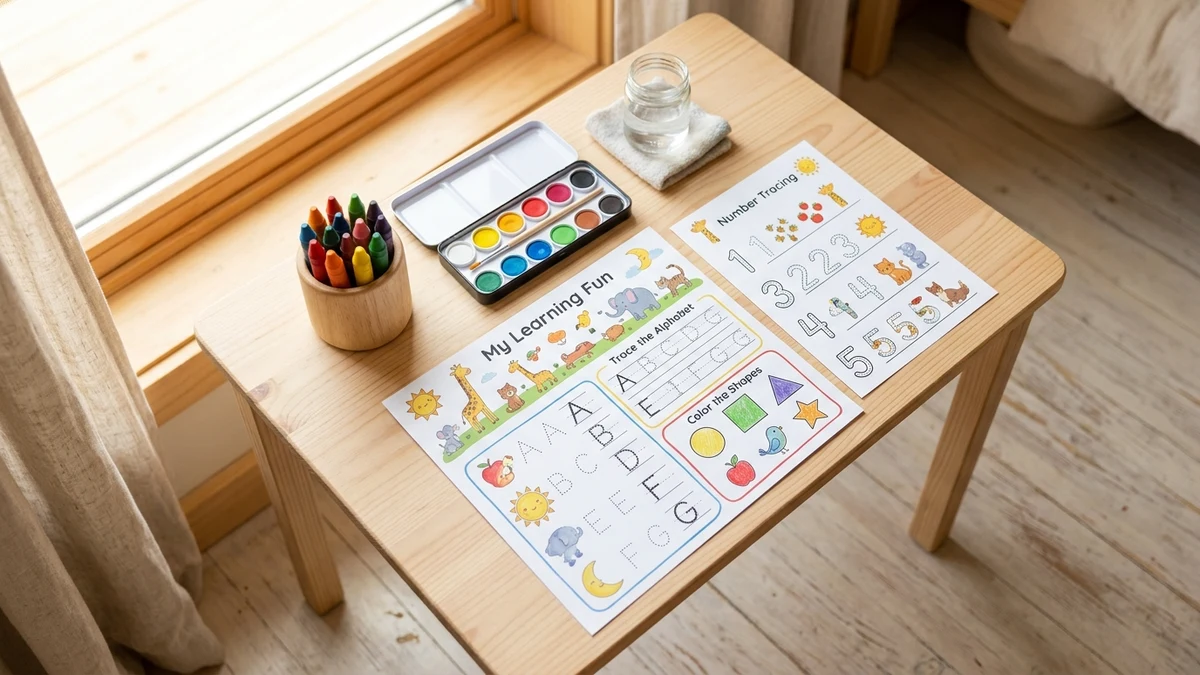
How Do Developmentally Calibrated Worksheets Support Preschool School Readiness?
Developmentally calibrated preschool worksheets support school readiness by isolating specific motor milestones—such as bilateral scissor control, hand arch stabilization, and top-to-bottom visual tracking—before expecting children to write letters. Short, joyful 5-to-10 minute practice sessions prevent hand fatigue while establishing confident pencil grip mechanics.
Many parents inadvertently introduce formal alphabet handwriting drills before a child's hand muscles have matured. When small children are forced to grip thin standard pencils, they frequently adopt tight fisted or hooked wrist compensatory grasps that become deeply entrenched habits.
By starting with purposeful pre-writing printables—such as thick zig-zag tracing paths, clothespin clip cards, and wide snip strips—children build the necessary intrinsic strength in their thenar muscles. Pairing worksheets with multi-sensory tools (broken crayons, triangular pencils, and textured cardstock) naturally facilitates the transition toward an ergonomic mature tripod grip.
Scissor cutting progression follows a strict developmental hierarchy. Children first master single snipping along narrow 1-inch cardstock strips, progress to continuous straight cutting across wider pages, and eventually tackle curved wave lines and geometric corners around age 4.
To maintain high engagement and avoid cognitive frustration, printable sessions should always conclude on a celebratory success note. Displaying completed cut-and-paste artwork on a low refrigerator gallery honors your child's emerging dexterity and motivates sustained daily practice.
Pencil Grip Progression & Fine Motor Milestone Schedule
Pencil Grasp Maturity & Wrist Extension Ratio
Variable Definition & Units
Independent finger motion isolating thumb, index, and middle finger
Wrist stabilized at 20–30 degrees extension against table or slant board
Hand cramp latency during seated fine motor tasks (target < 8 min)
Curriculum Worksheet Categories & Motor Milestones
Progressive Scissor Cutting Strips
Stage 1–2 (2–4 Yrs)- Primary Skill
- Bilateral Cutting & Thumb-Up Orientation
- Paper Weight
- Letter / 65lb Cardstock
From single straight snips to wavy serpent lines. Features heavy black guidelines and visual stop cues that build cutting confidence without tearing paper.
Pre-Writing Sensory Tracing Paths
Stage 2 (3–4 Yrs)- Primary Skill
- Top-to-Bottom Directionality & Wrist Stability
- Paper Weight
- Letter / 65lb Cardstock
Curved, zig-zag, and circular pathways for finger-tracing or dry-erase marker practice in reusable plastic sheet protectors.
Woodland Animal Counting Clip Cards
Stage 2–3 (3–5 Yrs)- Primary Skill
- Subitizing & Pincer Grasp Compression
- Paper Weight
- Letter / 65lb Cardstock
Features Smoky Mountain black bears, acorns, and trout (1–10). Children count physical items and clip a wooden clothespin onto the corresponding numeral.
Tactile Playdough Alphabet Mats
Stage 1–3 (2–5 Yrs)- Primary Skill
- Letter Formation & Hand Muscle Density
- Paper Weight
- Letter / 65lb Cardstock
Full-page capital and lowercase letter outlines. Children roll clay 'snakes' to fill letter cavities before transitioning to pencil-and-paper writing.
Pediatric OT Best Practices: Preventing Handwriting Fatigue
Use small writing utensils. Broken crayons (roughly 1 to 1.5 inches long) and golf pencils naturally force children into a tripod grip, as there is simply not enough room on the barrel for a fist to wrap around.
Incorporate vertical surfaces. Taping worksheets to an easel, refrigerator door, or wall promotes natural wrist extension and engages the shoulder girdle, providing a sturdy biomechanical base for refined finger movements.
52-Week Complete Preschool Curriculum & Printable Activity Bundle
Everything you need for an enriched homeschooling or classroom year: 1,200+ pages of ready-to-print worksheets, letter crafts, sensory schedules, and teacher pacing guides.
- 52 Structured Weekly Themes: Complete Monday–Friday multi-sensory pacing schedules.
- Alphabet Mastery (A–Z): Tactile playdough mats, phonics cards, and scissor-cutting worksheets.
- Pediatric OT Approved: Bilateral coordination, hand-eye tracking, and fine-motor developmental milestones.
Frequently Asked Questions About Printable Worksheets
What type of paper should you use when printing scissor cutting worksheets for young toddlers?
Print on 65lb cardstock rather than standard copy paper. Standard flimsy copy paper folds and buckles when toddlers squeeze scissors, whereas stiff cardstock provides firm resistance that guides successful cuts.
At what age should a child transition from a fisted palmar grasp to a static tripod grip?
Most children naturally transition from a fisted grasp to a digital pronate grasp (fingers pointing down) between ages 2 and 3, followed by a static tripod grip using the thumb, index, and middle finger between ages 3.5 and 4.5.
How can families reuse printable worksheets without reprinting hundreds of sheets?
Slide printed activity sheets into clear heavy-duty dry-erase pocket sleeves. Children can write and trace using washable dry-erase markers or lay playdough coils on top, wiping clean with a micro-fiber cloth for infinite daily practice.
How many minutes of pencil-and-paper worksheets are appropriate for a 4-year-old?
Pediatric occupational therapists recommend capping seated pencil worksheets at 5 to 10 minutes maximum per session for 4-year-olds. The vast majority of early childhood learning should remain tactile, playful, and physically active.